Gold at a Crossroads
Safe Haven or Overvalued Relic?
By: Michael Melander
Feb. 12, 2026
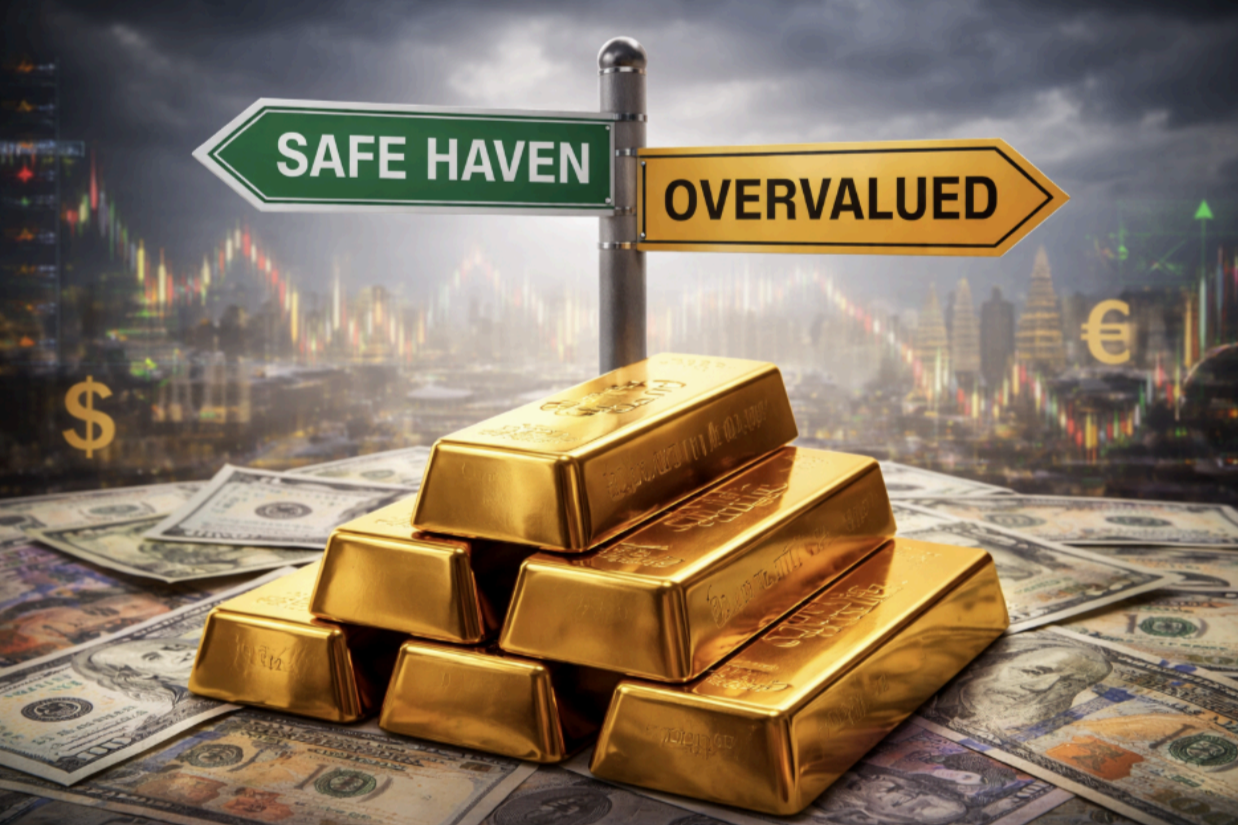
Gold at a Crossroads: Safe Haven or Overvalued Relic?
Gold has served as a global currency for centuries, facilitating cross-cultural trade, providing a hedge against financial uncertainty, and symbolizing monetary trust. In recent years, gold's financial position has strengthened significantly. Between 2024 and 2026, the price of gold increased by approximately 155%. This surge is attributed to rising inflation, increasing sovereign debt, and currency instability in multiple regions. Proponents of gold investment contend that these conditions may deteriorate further, prompting a flight to quality among investors. Conversely, critics assert that the current price of gold exceeds its intrinsic value, rendering it susceptible to a substantial decline in market value.
The truth lies somewhere within.
Currency Instability and Loss of Trust
A primary argument supporting gold investment is its correlation with currency instability. When confidence in fiat currencies, which are not backed by physical commodities, declines due to inflation, aggressive monetary expansion, or fiscal mismanagement, investors often allocate assets to gold and other precious metals.
In contrast to paper currencies, the global supply of gold is finite, making it resistant to dilution from monetary expansion. During periods of significant money supply growth, investors frequently use gold to preserve purchasing power.
This relationship remains evident in the current economic environment. Following the COVID-19 market shock, many economies have experienced heightened inflation, rising domestic debt, and the implementation of expansionary monetary policies. In such contexts, gold investment serves primarily as a means of capital preservation rather than speculation. This tendency is reinforced when central banks expand their gold reserves.
The Counterargument: Limited Utility and Valuation Concerns
Despite its long-standing historical significance, gold remains the subject of substantial criticism. Unlike equities or bonds, gold does not produce cash flow, earnings, dividends, or interest, which complicates its valuation through conventional financial models. Its price is primarily influenced by investor sentiment rather than quantifiable productivity
Critics contend that gold’s industrial applications, though present, are minimal relative to its overall market value. In contrast, other finite precious metals, such as silver, possess substantial industrial utility, particularly in electronics, solar panels, medical devices, batteries, and advanced technologies, owing to their high conductivity and antimicrobial characteristics. Consequently, a significant portion of gold’s price is attributed to its role as a monetary asset rather than its practical utility. Should inflation stabilize, currencies appreciate, and confidence in monetary policy be restored, the “insurance premium” embedded in gold prices may decline.
Consequently, some investors may reallocate capital toward silver and other industrial metals, perceiving them as offering a distinct risk profile compared to gold. These metals are integral to manufacturing, renewable energy, and technological innovation, which supports their value through both scarcity and sustained real-world demand. This industrial basis provides fundamental price support that is less susceptible to macroeconomic instability or monetary uncertainty.
A Hedge, Not a Certainty
Gold currently occupies a pivotal position. It may continue to benefit if currency instability, inflationary pressures, and geopolitical uncertainty persist. Conversely, it faces significant risks should confidence in fiat currencies increase, and real interest rates rise.
Rather than considering gold as inherently overvalued or infallible, investors may benefit from regarding it as a financial tool rather than a comprehensive investment thesis. Its relevance is determined less by industrial demand and more by trust in monetary systems, policy, and institutions.
In an increasingly uncertain global environment, trust in monetary and institutional systems remains fragile. The future trajectory of gold will depend not solely on market sentiment, but on the global capacity to balance stability with disruption.
