Designing AI Data Centers for Efficiency
Cooling, Density, Location, and Sustainability
By: Sophie Nannemann
Jan. 27, 2026
The explosive growth of AI has turned electricity into the scarcest input in the digital economy. Previous articles in this series examined how renewable energy, power procurement strategy, and grid access are rapidly becoming competitive moats for AI infrastructure operators. But power supply is only half of the equation.
The other half is demand.
If renewables determine where AI data centers can be built, efficiency determines how many megawatts those facilities actually require, and whether renewable power can scale fast enough to keep pace with AI’s exponential growth. In this sense, data-center design is no longer a back-office engineering concern. It is now a core strategic lever shaping cost structure, carbon exposure, and ultimately firm valuation.
This article explores how AI data centers themselves are being re-engineered to consume fewer megawatts per unit of compute, through advances in cooling, density, modularity, siting, and intelligent load management, and why these efficiency gains are essential to making renewable-powered AI economically viable.
The New Efficiency Stack: Where Megawatts Are Won or Lost
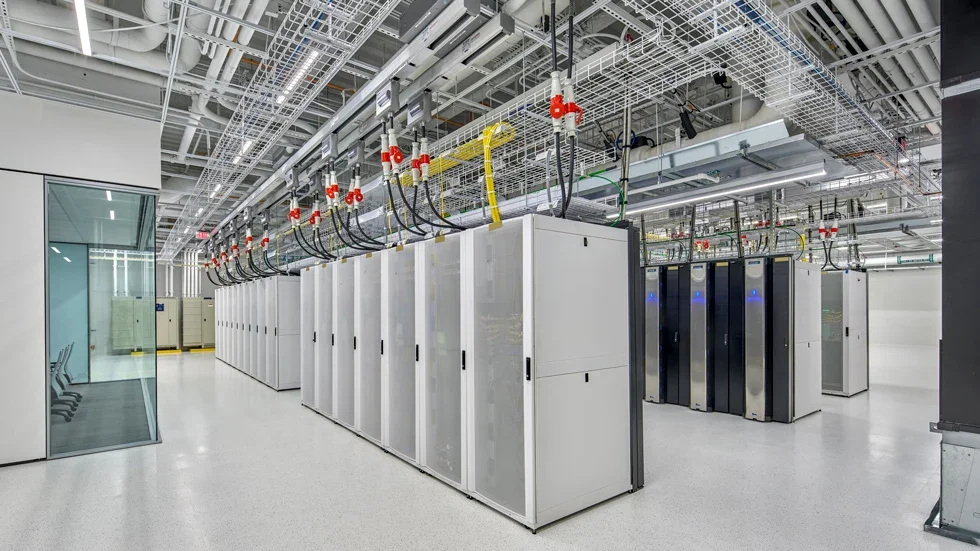
Traditional cloud data centers were designed around general-purpose CPUs, relatively low rack densities, and air-based cooling. AI has shattered those assumptions. GPU and accelerator-heavy racks now draw multiples of the power per square foot, pushing thermal loads beyond what legacy designs can handle.
To respond, operators are pulling several efficiency levers simultaneously:
Advanced cooling technologies, including direct liquid and immersion cooling
Rack density optimization, packing more compute into smaller footprints
Modular and prefabricated designs, reducing construction time and inefficiency
Strategic site selection, favoring cool climates, renewable-rich regions, or proximity to load
Software-driven load orchestration, aligning compute demand with power availability
Individually, these measures shave marginal megawatts. Together, they fundamentally reshape the energy profile of AI infrastructure.
Why High-Density AI Racks Change Everything
AI workloads concentrate enormous power in compact spaces. A single AI rack can draw 30–80 kW today, with next-generation systems pushing even higher, compared to 5–10 kW in legacy enterprise data centers. That density explosion creates two compounding challenges:
Heat becomes the binding constraint, not just power delivery
Cooling systems themselves become major energy consumers
In traditional facilities, cooling might account for 30–40% of total electricity use. In poorly optimized AI centers, that figure can climb even higher. Every inefficiency in thermal management translates directly into higher grid draw, higher operating costs, and higher carbon intensity.
This is why cooling innovation sits at the center of modern AI data-center design.
Technologies Redefining Efficiency
Direct Liquid and Immersion Cooling: Air cooling is reaching its physical limits. Liquid cooling, where coolant is brought directly to chips, transfers heat far more efficiently than air. Immersion cooling goes further, submerging entire servers in dielectric fluid.
The benefits are substantial:
Dramatically lower cooling energy requirements
Support for higher rack densities without overheating
Reduced need for large HVAC systems
Liquid-based cooling can cut cooling-related power consumption by double-digit percentages, effectively converting wasted thermal energy into reclaimed efficiency.
Waste Heat Recovery
What was once treated as waste is increasingly seen as an asset. AI data centers generate enormous quantities of low-grade heat, which can be reused for: District heating networks, commercial or residential buildings, industrial processes in cold climates
In Nordic countries, data centers already feed waste heat into municipal heating systems, offsetting fossil fuel use while improving overall system efficiency. While not universally applicable, heat recovery turns data centers from pure energy sinks into partial energy contributors.
Location and Climate Optimization
Geography matters. Cooler ambient temperatures reduce cooling loads year-round. Proximity to hydroelectric, wind, or geothermal resources reduces transmission losses and grid congestion risk.
This is why AI investment is clustering in the Nordics (hydro & cold climate), canada (hydro & land availability), and parts of the U.S. Southwest (solar & storage, despite heat).
Location choice directly shapes power usage effectiveness and long-term operating costs, making siting decisions inseparable from energy strategy.
Modular and Prefabricated Data Centers
Speed is critical in a capital-driven AI arms race. Modular data centers allow operators to deploy standardized, factory-built units near renewable hubs or behind-the-meter generation.
Efficiency advantages include optimized airflow and cooling layouts, reduced construction waste and time, easier scaling in response to power availability.
Modularity also pairs naturally with renewables, enabling capacity to expand incrementally rather than through monolithic builds that strain grids.
Adaptive Load Scheduling
Not all AI workloads are equally time sensitive. Training runs, batch inference, and certain optimization tasks can be scheduled to align with peak renewable generation, low grid pricing, favorable carbon intensity windows.
By dynamically shifting load, operators smooth demand profiles, reduce reliance on peaker plants, and extract more value from intermittent renewables. Software, in this sense, becomes an energy efficiency tool.
Why Efficiency Makes Renewables Scalable
Renewables alone cannot meet AI’s demand if consumption continues to rise unchecked. Efficiency reduces the problem at its source.
Lower megawatt requirements mean:
Fewer renewable projects needed per data center
Smaller storage systems required for intermittency
Reduced grid stress and reserve margin pressure
Faster permitting and deployment timelines
In effect, every efficiency gain amplifies the impact of each renewable megawatt installed. This is what makes clean power strategies financially viable rather than merely aspirational.
Measuring What Matters: From PUE to Carbon and Water
Efficiency must be measurable to be investable. Key metrics include:
PUE (Power Usage Effectiveness): Total facility power divided by IT power. Best-in-class AI centers are pushing toward 1.1–1.2.
CUE (Carbon Usage Effectiveness): Carbon emissions per unit of IT energy consumed.
Water Usage Effectiveness: Increasingly scrutinized as liquid cooling scales.
These metrics are no longer just operational benchmarks; they are inputs into ESG scoring, financing terms, and public-market credibility.
From Engineering Choices to Strategic Advantage
Efficiency is no longer a technical afterthought. It sits at the intersection of:
Strategy: Where and how firms build
Business models: Predictable opex and scalable margins
Financing: Lower risk profiles for investors and lenders
Sustainability reporting: Credibility in carbon disclosures
Valuation: Resilience in constrained energy markets
As AI companies move toward IPO readiness, they will increasingly be judged not only on model performance, but on whether their infrastructure can scale without collapsing under energy costs or regulatory pressure.
Looking Ahead: The Convergence of Power, Design, and Capital
Renewables address the supply side of AI’s energy problem. Efficiency reshapes demand. Together, they define the future architecture of the AI economy.
The final article in this series will bring these threads together — examining how power strategy, infrastructure design, financing structures, and sustainability reporting converge into a new operating model for AI companies navigating a world where compute is abundant, but megawatts are not.
