Boom to Breakdown
The Commodities Crash
By: Sophia Paul
Feb. 6, 2026
Current Market Snapshot
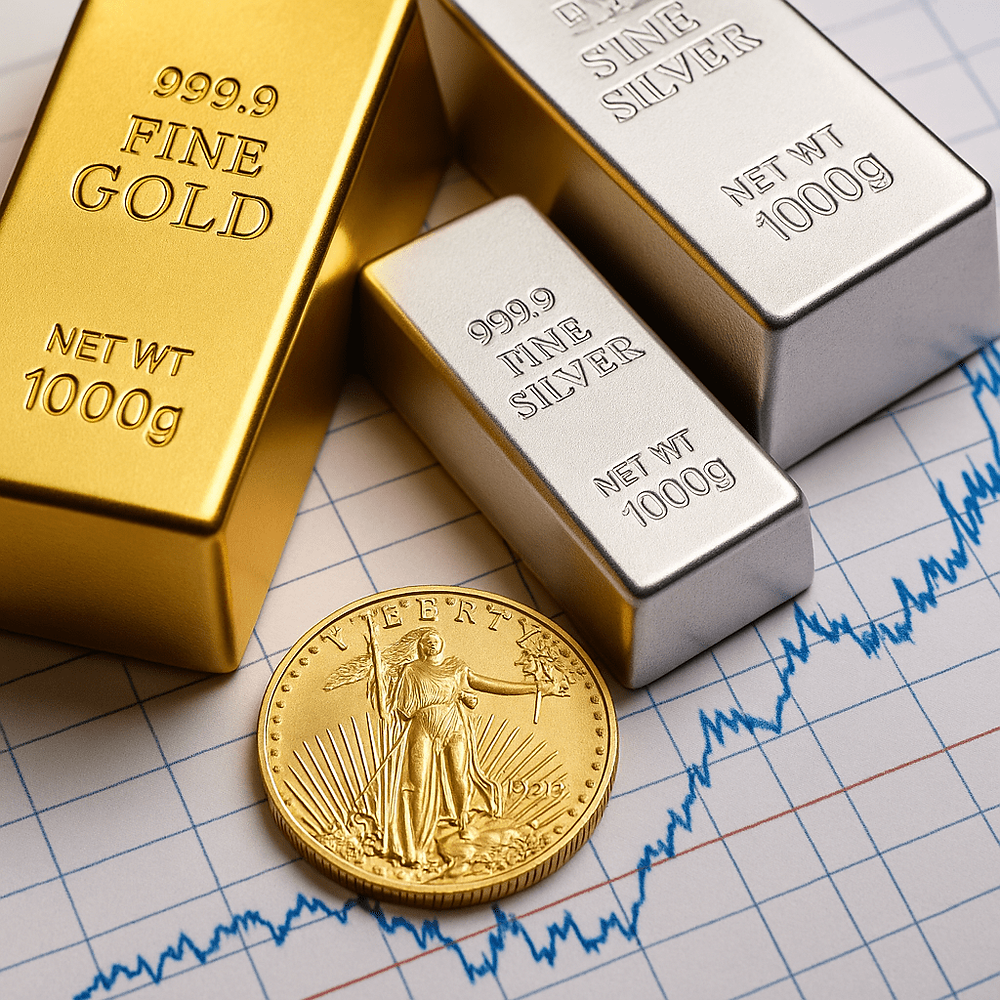
Commodity prices fell sharply on January 30, 2026, with losses extending into February 1. Gold dropped nearly 10 percent, falling from over $5,500 per ounce to approximately $4,770. Silver declined more than 30 percent, sliding from $121 per ounce to $78.70. In total, the sell-off erased more than $7 trillion in market value, marking the largest single-day loss for these commodities since 1983.
Prices have since staged a partial recovery. Many analysts argue the downturn reflects a long overdue correction following an exceptionally strong rally, rather than a broader collapse, with expectations that prices will stabilize over time.
History and Trends
Gold has historically served as a hedge during periods of economic uncertainty, a role reinforced by central banks worldwide. When confidence in the U.S. dollar weakens, central banks often reduce dollar reserves in favor of gold. Because gold is not tied to any single government, it offers diversification and perceived security.
That role was formalized in 1944 with the Bretton Woods system, which established the dollar as the world’s reserve currency and fixed gold at $35 per ounce. The system collapsed in 1971, allowing both gold and the dollar to float freely. Gold prices surged in the years that followed, peaking in the early 1980s before falling sharply from $675 per ounce to $256.
Silver followed a more volatile trajectory. Under Bretton Woods, silver traded below $1 per ounce and held limited monetary significance. After the system’s collapse, silver surged to $49.45 per ounce before falling to $10.80 during the early 1980s downturn, an event later known as Silver Thursday.
What is Driving Volatility?
At the core of the recent turmoil is uncertainty. Gold is widely viewed as a defensive asset, while silver is often treated as a higher-risk opportunity for sizable returns. Analysts cite several factors behind the sudden decline. After months of rapid price appreciation, a correction may have been inevitable, with speculation accelerating the sell-off.
Another source of volatility is political uncertainty surrounding monetary policy. The administration’s nomination of Kevin Warsh as chair of the Federal Reserve has sparked debate among investors. Some believe his leadership would strengthen the dollar, reducing demand for gold. Others fear increased political influence over the Fed, a scenario that could ultimately drive investors toward gold as a hedge.
Gold
For centuries, gold has maintained monetary value, with prices rising steadily over time. Since the collapse of the Bretton Woods system, gold has appreciated at an average annual rate of roughly 8-9% percent. Over the past year alone, prices surged by 65 percent, reaching a record high above $5,500 per ounce.
This rally was driven largely by gold’s reputation as a safe haven asset. Its liquidity, stability, and independence from any single government have made it increasingly attractive amid rising geopolitical tensions and growing concerns about U.S. trade deficits. As confidence in the dollar weakened, central banks shifted reserves toward gold, a move closely followed by private investors.
Silver
Silver, while classified as a precious metal, has never matched gold in value. It is more abundant and chemically reactive, tarnishing over time in ways gold does not. Silver also plays a significant role in industrial applications, including electronics, currency production, and medical devices.
Despite its utility, silver lacks the scarcity that underpins gold’s price and remains far more volatile. While this deters risk-averse investors, it presents opportunities for those willing to tolerate price swings. Historically, silver prices have risen between 8 and 15 percent annually, though in 2025 prices surged by 145 percent.
That rally was driven by a fifth consecutive year in which global demand exceeded supply, largely due to industrial and technological development. Elevated volatility has produced incredibly wide price spreads of $6 to $9, creating opportunities for arbitrage.
Looking to the Future
While both metals suffered steep losses, long-term trends suggest continued growth. Gold has followed a consistent upward trajectory since the end of the Bretton Woods system and is expected to maintain that pattern. Silver remains unpredictable, but analysts largely anticipate a full recovery.
Market participants remain optimistic that both commodities will regain strength over the course of the year. Analysts have largely marked gold as a long-term buy-and-hold asset, supported by its historical resilience and role as a monetary hedge. Silver, while carrying greater volatility, has also been identified by analysts as a long-term buy-and-hold opportunity, albeit with higher risk. Market corrections remain a natural feature of commodity cycles, and history suggests that volatility alone is rarely a reason for panic.
