The Ceasefire Was Always About the Supply Chain
By: Spencer Graham
Apr. 9, 2026
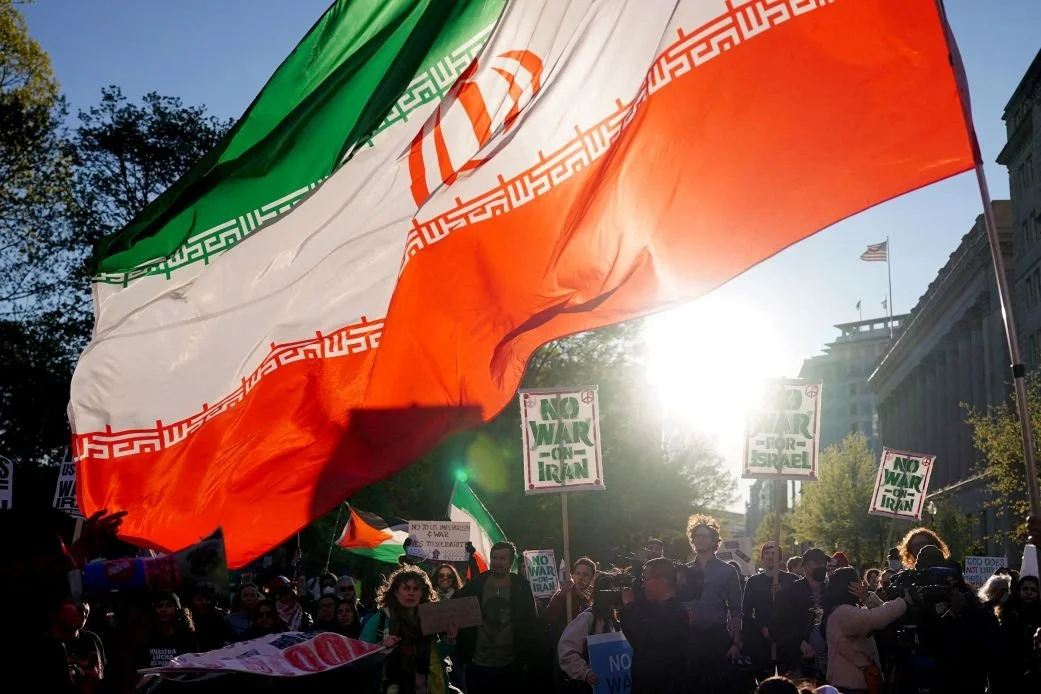
On April 7th, Donald Trump announced a two-week ceasefire with Iran, contingent on Iran reopening the Strait of Hormuz immediately. As a result, crude oil futures dropped 9% within the hour. But a ceasefire doesn’t immediately solve the problem with oil that has yet to hit the United States. The oil, fertilizer, and petrochemicals that stopped moving five weeks ago don't get instantly moved to their designated location. The main problem with the transportation of oil is speed.
The Trump administration has had a clear goal in negotiations with Iran: to reopen the Strait of Hormuz. This agenda is obvious based on the events of April 7th. Donald Trump threatened Iran when he said, “a whole civilization will die tonight”, then 8 hours later, the administration was able to negotiate a ceasefire contingent on the Strait being opened.
It isn’t a military calculation or a diplomatic one, but instead it is economic. The delayed supply chain consequences of a closed Strait are so severe and so politically dangerous that the administration cannot afford to let the disruption persist. The pattern of threats followed by backtracking is the tell.
Six weeks ago, the oil market was oversupplied, and prices were stable. Then the United States and Israel started a war with Iran that changed the entire landscape. The war in the Middle East has since sparked the biggest oil supply disruption on record, sidelining an estimated 12 to 15 million barrels of crude per day CNN.
Tanker traffic has gone from 130 ships per day to around 1-3 per day since the war started NYT. The EIA projected that Iraq, Saudi Arabia, Kuwait, UAE, Qatar, and Bahrain collectively shut in 7.5 million barrels per day of crude production in March alone. Shut-ins projected to rise to 9.1 million barrels per day in April U.S. Energy Information Administration, assuming the war is ongoing.
The oil supply chain isn’t a digital network. It moves at the speed of tankers. Oil tankers move extremely slowly; they typically cruise at speeds of 12 to 17 knots, which is 14 to 20 mph. This is a common speed for a bicycle. Meaning that the oil that was sent out just before the war started hasn’t reached the United States yet.
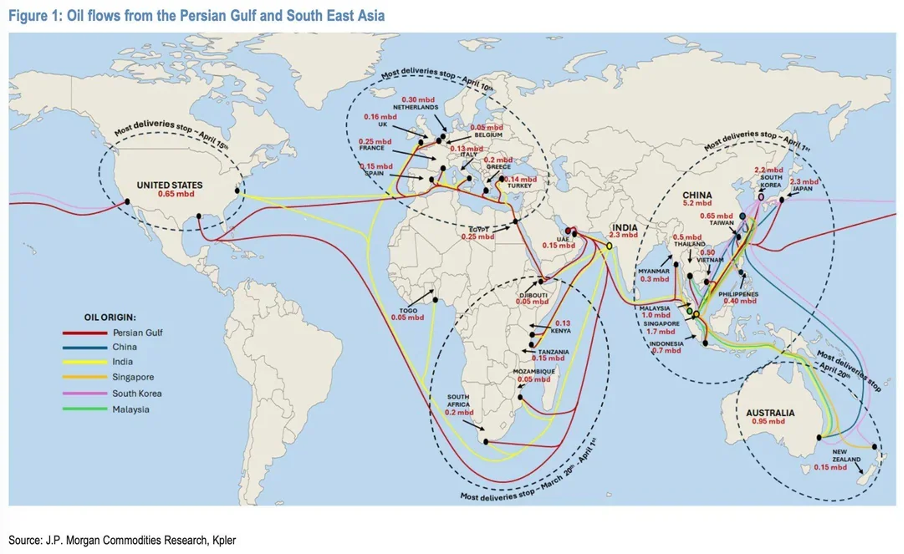
This image highlights that the United States hasn’t felt the impact of the war just yet. It is similar to seeing a bomb go off, but the sound is lagging behind.
What most coverage is missing is how far the disruption runs beyond oil. The Strait is the exit ramp for fertilizer, sulfur, and petrochemical feedstocks. The ingredients that sit inside almost every crop planted this spring and almost every manufactured good on a shelf.
Approximately 30-34% of the world's fertilizers come from this area of the world. As well as 46-54% of the world's urea trade and 30% of global ammonia. Urea was $482.50 per ton on February 27. By mid-March, it was $720. Ammonia climbed 24 percent in the same stretch. Price is not the main concern with urea and ammonia; it is timing. In weeks, farmers are going to begin planting, and higher costs mean that farmers can’t afford as many inputs. Meaning that they will gross lower yields, resulting in higher food prices when these crops make it to shelves.
The sulfur situation compounds this. Roughly 44 to 50 percent of the world's seaborne sulfur is a byproduct of Gulf oil and gas refining, and it's trapped on the wrong side of the blockade. Sulfur is what gets converted into sulfuric acid, which is what turns raw phosphate rock into something plants can absorb. A decrease in sulfur supply leads to higher prices in phosphate, leading to higher fertilizer costs.
This wasn't the first time. On March 21, Trump gave Iran 48 hours to reopen the Strait or face strikes. Then he delayed. He has now set and walked back hard deadlines at least three times.
All 3 times, every threat, every extension, every backtrack was targeted to reopen the Strait.
The diplomatic explanation is maximum pressure leading to a deal. But Vance said something on Tuesday morning that cut closer to the real issue. Iran, having lost the military contest, is now trying to "exact as much economic pain" on the world by keeping the Strait closed. That's not a diplomatic issue. That's an admission of what the administration is actually afraid of.
The EIA forecasts diesel above $5.80 per gallon this month and retail gas averaging above $3.70 for the year, and those projections assume the conflict ends quickly. The national average is already $4.11 per gallon. A month ago, it was $3.25.
The deeper issue is that even a ceasefire doesn't fully undo what's already happened. The planting window doesn't wait for diplomatic timelines. Fertilizer production and transport take weeks to restart. Weeks that farmers in the Northern Hemisphere are running out of right now. That's why the reopening of the Strait is so important to the President and to this country. The Strait isn't a military objective anymore; it's an economic emergency.
The Strait of Hormuz doesn't usually show up in conversations about domestic economic policy. It should right now. Every threat, every deadline, every backtrack from this administration traces back to the same pressure point. It's a supply shock still working through the system, and a political calendar that doesn't have room for $5 diesel and $8 corn by August.
The slow burn started on February 28. It has a while left to run.
