Quantum Computing's Uncertain Bet on Wall Street
By: Paytyn Newton
28 September, 2026

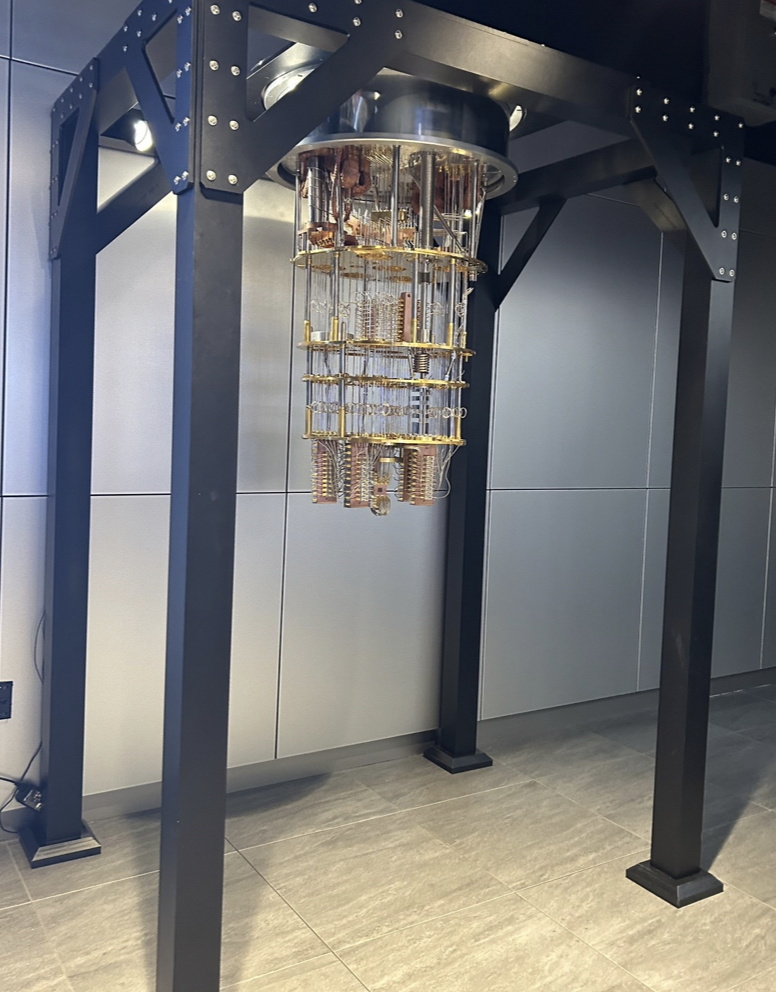
An IBM Quantum System One, photographed at IBM's Thomas J. Watson Research Center in Yorktown Heights, NY.
Photo: Onri Jay Benally / Wikimedia Commons (CC BY 4.0)
Introduction
Quantum computing has spent the last decade oscillating between two narratives: a breakthrough that will rewrite the limits of computation and a lab curiosity that is perpetually “five to ten years away.” For most industries, that uncertainty is reason enough to wait. Finance has not waited. Banks including JPMorgan Chase, Goldman Sachs, HSBC, and Wells Fargo have all built internal quantum research teams or signed partnerships with quantum hardware makers, years before the technology is expected to outperform classical computers at any task that actually matters to a trading desk.
That gap—real capital committed today against a payoff that may not arrive until the 2030s—is what makes quantum computing a useful case study for how markets price emerging technology long before it is commercially proven.
The Basic Mechanics, Briefly
Classical computers store information as bits, each strictly a 0 or a 1. Quantum computers use qubits, which can exist in a superposition of both states at once and can be entangled with one another so that the state of one qubit is correlated with another regardless of distance. In theory, this lets a quantum computer explore a vast number of possible solutions to a problem simultaneously rather than checking them one at a time.
The catch is that qubits are extremely fragile. Heat, electromagnetic noise, and even cosmic rays can cause “decoherence,” corrupting the calculation. Today’s machines are widely described as being in the NISQ era—Noisy Intermediate-Scale Quantum—meaning they have enough qubits to be interesting but not enough error correction to be reliably useful for most real-world problems. Getting to a “fault-tolerant” quantum computer, one that can run long, error-corrected calculations, is the milestone the entire industry is racing toward. IBM has publicly targeted a fault-tolerant system, internally named Starling, by around 2029. Google’s December 2024 “Willow” chip made headlines for demonstrating that error rates can actually fall as more qubits are added—a threshold result, not a finished product.
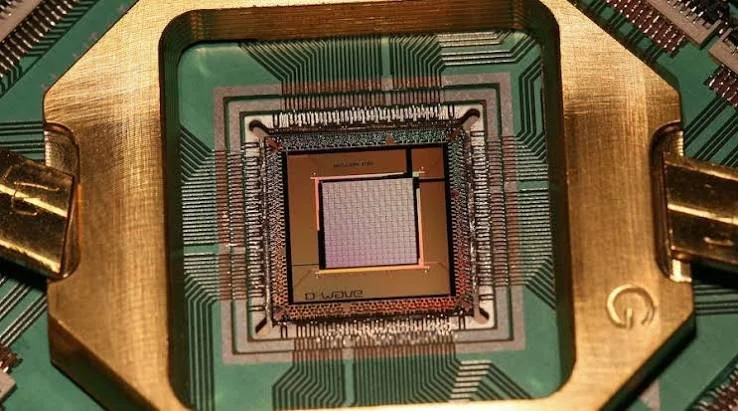
A D-Wave 1000-qubit quantum annealing processor chip, wire-bonded in its sample holder.
Photo: Mwjohnson0 / Wikimedia Commons (CC BY-SA 4.0)
Where Finance Thinks Quantum Actually Helps
Finance is an attractive target for quantum computing because so much of it reduces to optimization and probability problems that get exponentially harder as they scale—exactly the kind of problems quantum algorithms are theoretically suited for.
Portfolio optimization
Choosing an optimal mix of assets across constraints like risk tolerance, sector exposure, and transaction costs is a combinatorial problem that becomes intractable for classical computers as the number of assets grows. Quantum approaches like the Quantum Approximate Optimization Algorithm (QAOA) aim to search that space more efficiently.
Derivatives pricing and risk simulation
Much of derivatives pricing and risk management, including Value-at-Risk calculations, relies on Monte Carlo simulation: running millions of random scenarios to approximate an outcome. Quantum algorithms promise a theoretical quadratic speedup for this kind of simulation, which would meaningfully cut the time needed to price complex instruments or stress-test a portfolio.
Fraud detection and credit modeling
Quantum machine learning is being explored as a way to detect subtle patterns in transaction data that classical models miss and to improve credit risk models that depend on large, high-dimensional datasets.
Cryptography, the other side of the ledger
Quantum computing is not just an opportunity for finance; it is also a threat. Shor’s algorithm, if ever run on a sufficiently powerful fault-tolerant machine, could break the RSA and elliptic-curve encryption that underpins nearly all banking security and blockchain infrastructure. This has produced a “harvest now, decrypt later” concern: adversaries stealing encrypted financial data today in the expectation that they can decrypt it once quantum computers catch up. In response, the U.S. National Institute of Standards and Technology finalized its first post-quantum cryptography standards in August 2024, and banks are now under pressure to begin migrating their systems well ahead of any working quantum decryption threat.
Who Is Actually Building This
On the hardware side, the field is led by a mix of tech giants and pure-play startups: IBM, Google, and Microsoft, alongside smaller public companies like IonQ, Rigetti Computing, D-Wave Quantum, and the privately held Quantinuum. Financial institutions have generally chosen to partner rather than build from scratch. JPMorgan’s Global Technology Applied Research team has published work on quantum algorithms for options pricing and has partnered with hardware providers. Goldman Sachs has a dedicated quantum computing research group exploring derivatives pricing applications. HSBC has run pilots with IBM’s quantum systems on foreign exchange and fraud use cases. These partnerships function less like near-term deployments and more like optionality: a relatively small research budget that buys a seat at the table if and when the technology matures.
Journalists tour IBM's Think Lab at the Thomas J. Watson Research Center, home to IBM's quantum systems, January 2025.
Photo: Foreign Press Center / Wikimedia Commons (Public Domain)

An IBM Quantum System Two installed at Ikerbasque, the Basque Foundation for Science, in Spain Europe's first, December 2025.
Photo: Luistxo / Wikimedia Commons (CC BY-SA 4.0)
Why Investors Should Be Skeptical of the Timeline
The hardest part of covering quantum computing as a financial story is separating the technology’s genuine long-term potential from a hype cycle that has already inflated and deflated once before, notably after IBM and Google’s competing “quantum supremacy” claims in the late 2010s. Every major roadmap in the industry has slipped at least once. Useful, fault-tolerant quantum computing capable of outperforming classical supercomputers on real financial problems is still generally estimated to be years away, and several researchers caution it could be a decade or more before error correction is solved at commercial scale.
For public-market investors, this creates a familiar pattern: richly valued, revenue-light stocks like IonQ and Rigetti trading heavily on narrative and partnership announcements rather than earnings, alongside quantum-focused ETFs (such as Defiance’s QTUM) that bundle that speculative exposure with more diversified, profitable companies like IBM and Alphabet. It is a dynamic worth comparing to earlier waves of thematic investing, from the dot-com buildout to the more recent AI infrastructure rally, where the underlying technology was directionally real but the timeline for monetization was consistently overestimated by the market.
Conclusion
Quantum computing’s place in finance today is less about what the technology can do and more about what banks are willing to pay to not be caught flat-footed if it works. That hedge is rational at the scale of a JPMorgan or a Goldman Sachs, where a small research budget is a rounding error. It is a much riskier bet for retail investors buying into quantum pure-play stocks on the assumption that a breakthrough is imminent. The more durable story, at least for now, is not quantum computing beating classical computing at trading, but the quieter, more urgent one: the race to protect financial infrastructure before quantum computing gets good enough to break it.