Renewable Energy in AI Data Centers
Opportunities & Approaches
By: Sophie Nannemann
Jan. 10, 2026
Why Renewables Matter for AI Data Centers
AI data centers sit at the intersection of three accelerating pressures: carbon exposure, operating costs, and explosive demand growth.
First, the carbon footprint is becoming impossible to ignore. High-density AI facilities consume several times the electricity of traditional cloud centers. As public markets, regulators, and institutional investors sharpen ESG scrutiny, the carbon intensity of AI infrastructure is moving from a public-relations issue to a valuation risk.
Second, renewables offer long-term cost advantages. Unlike fossil-fuel generation, which is exposed to commodity price volatility and geopolitical risk, wind, solar, hydro, and geothermal provide electricity with stable, predictable marginal costs once installed. For data-center operators facing rising operating expenses (opex), energy price certainty is now as valuable as chip access.
Third, renewables are uniquely positioned to scale with AI demand growth. Traditional baseload generation requires long development cycles. Renewable generation, especially solar and wind, can be deployed faster, in modular increments, and in closer proximity to where data centers are actually being built.
In short, renewables are no longer just a sustainability gesture. They are becoming a growth enabler.
Renewable Energy Solutions & Architectures
The renewable transition in AI infrastructure is not unfolding through a single model. Instead, operators are assembling hybrid energy architectures that balance reliability, cost, speed to market, and regulatory constraints.
1. On-Site Generation: Solar Arrays and Wind Turbines
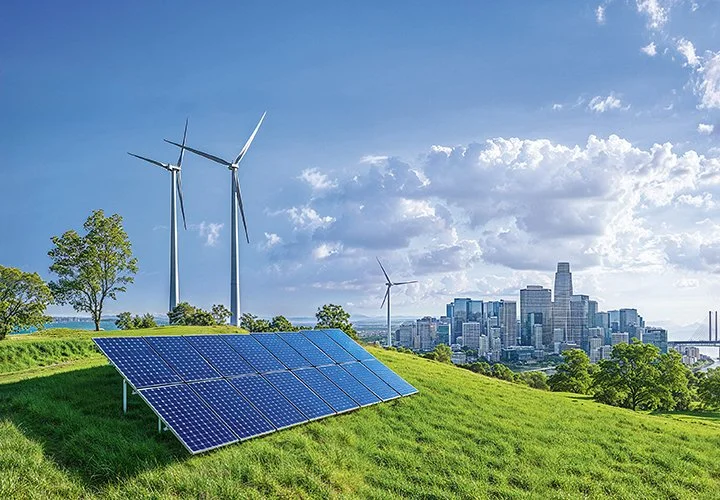
Large-scale data centers are increasingly designed with co-located solar fields or wind installations. This approach allows facilities to generate a portion of their electricity directly, reducing transmission dependency and easing the burden on strained regional grids. On-site generation also functions as a hedge against grid congestion delays, one of the most common causes of stalled data-center projects today.
2. Power Purchase Agreements (PPAs)
PPAs have become one of the most important financial tools in renewable data-center development. Through long-term contracts with renewable developers, operators lock in megawatts at pre-agreed prices for 10, 15, or even 25 years. For renewable developers, PPAs de-risk financing. For data-center operators, they transform electricity from a volatile operating cost into a modeled, financeable asset stream.
3. Above-the-Meter and Behind-the-Meter Power
Above-the-meter arrangements feed power directly into the grid before delivery to the facility, while behind-the-meter systems send power straight from generator to data center without passing through public transmission networks. The latter model is gaining traction because it bypasses congested grid interconnects entirely, accelerating deployment timelines.
4. Energy Storage: Batteries as Grid Shock Absorbers
Renewables introduce intermittency, but battery storage is rapidly closing that gap. AI data centers are deploying grid-scale batteries to:
Store power during peak solar or wind generation
Discharge during nighttime inference surges
Stabilize grid draw during reserve shortages
Storage turns intermittent renewable production into dispatchable power, a crucial requirement for always-on AI workloads.
5. Hybrid Systems: Renewables + Natural Gas or Nuclear
To ensure uptime and reliability, many facilities pair renewables with natural gas peaker plants or nuclear baseload. These hybrid systems allow operators to scale rapidly without exposing clients to downtime risk, an unacceptable outcome for high-value training and inference clusters.
How These Approaches Address the Core Challenges
Renewable deployment is not cosmetic, it directly attacks the infrastructure constraints identified in earlier articles.
Grid Bottleneck Mitigation: Behind-the-meter generation and co-located renewables reduce dependence on congested transmission networks.
ESG and Reputational Protection: Clean power reduces emissions intensity and shields operators from regulatory backlash.
Cost Stability: Long-term PPAs lock in electricity pricing and protect AI firms from rising opex volatility.
Capital Market Appeal: Investors increasingly favor operators that demonstrate power security alongside compute scalability.
In this way, renewables convert energy from a growth limiter into a competitive lever.
Market Momentum
Across North America, Europe, and Asia, data-center operators are actively restructuring their power strategies around renewables:
Hyperscalers are anchoring gigawatt-scale wind and solar projects through multi-decade PPAs.
Nordic data centers are exploiting abundant hydroelectric power and cold-climate efficiency for large-scale AI deployment.
Southwestern U.S. projects are leveraging high solar yields combined with storage and gas backup.
What unites these efforts is not climate signaling, it is capacity security under grid stress.
Barriers & Structural Constraints
Renewables are not a silver bullet. Several structural barriers remain:
Land Use: Large solar and wind installations require extensive land footprints.
Intermittency: Batteries reduce but do not eliminate reliability concerns.
Storage Cost: While falling rapidly, grid-scale batteries still add substantial capex.
Regulatory Fragmentation: Permitting timelines vary dramatically by jurisdiction.
Grid Integration: Even renewable plants must ultimately interact with aging transmission infrastructure.
These constraints ensure that renewable buildouts will remain complex hybrid systems rather than simple plug-and-play solutions.
From Power Supply to Power Efficiency
Renewables solve the supply side of the energy equation. But supply alone cannot keep pace with exponential AI demand.
The next article in this series turns to the demand side: how data-center design, cooling systems, and architectural efficiency can shrink the megawatt footprint itself, allowing every renewable kilowatt to deliver greater economic and computational value.
